Now then, let me introduce you to a friend of mine.
She’s the sort of person who walks into a room and the room immediately feels like it needs to try harder. Full of energy, full of colour, full of ideas. If there’s a bold choice to be made, she’s made three of them before you’ve finished your tea and she’s working on another.
There’s a big extension going on and she’s re-vamping her kitchen.
Lime green walls. Purple units. And four ovens. I’ll say that again. Four ovens. I’ve no idea what’s going in the fourth one, we’ll wait and see .
Anyway, knowing woodwork’s my thing, she came to me with a job. “Calling favours in” she said, and I owe her plenty. Her kitchen door had a vertical bar across the top aperture, splitting it into two smaller panes of glass. She wanted it out. A very talented friend of hers was making a bespoke stained glass panel, and she needed the full aperture to show it off properly.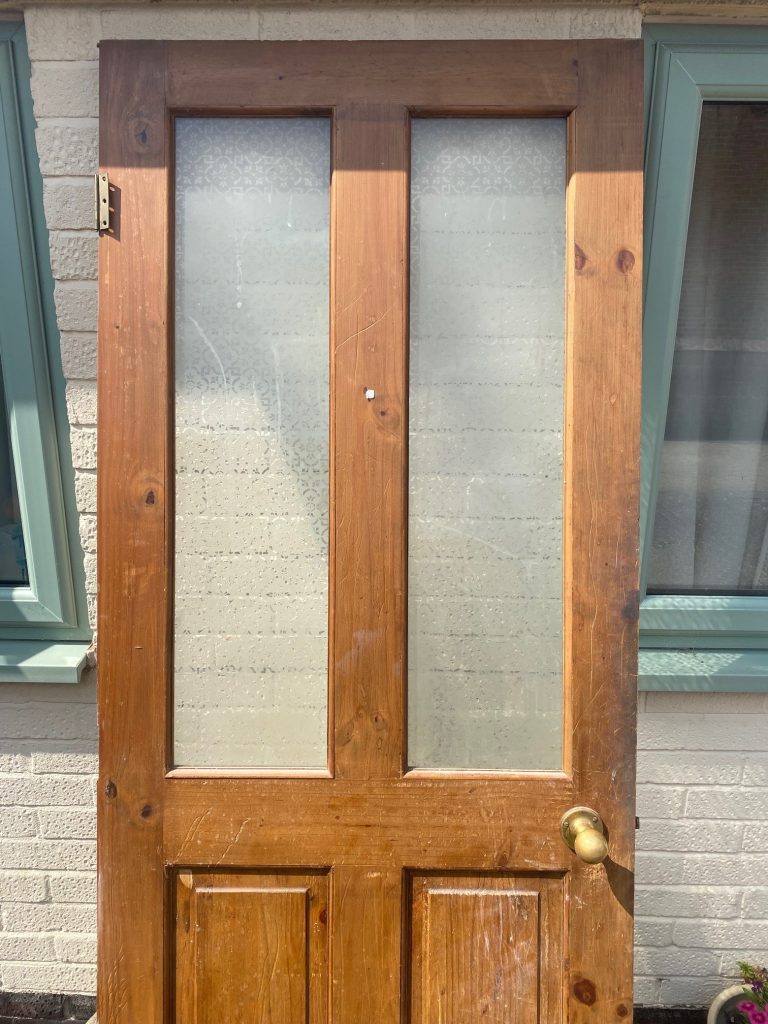
Fair enough. Straightforward on the face of it.
My first instinct was to slow down a bit.
A kitchen door gets a hard life. It opens, closes, takes an elbow when your hands are full, and now and again gets a clout from someone backing out with a full laundry basket. So a fair amount of stress going through the door every day. There’s a youngster in the house too.
My concern was simple enough. Remove the bar, and you’ve got a single large aperture in a door that gets hammered by regular traffic. The glass needs to be solid enough to handle that without flexing or working loose over time. Just me thinking about the makeup of a stained glass aperture. At that size, in that location, it wasn’t something that warranted not thinking about.
So I said as much, and she was receptive.
This is something I’d encourage anyone to do, by the way, whether you’re a seasoned woodworker or just starting out. If something gives you pause, say so. A good client respects it. And my friend, daft as she is about ovens, is a good client.
She went back to the glassmaker, who confirmed the build would be solid. The leading, the construction, the rigidity of the finished panel. She knew what she was on with and she’s built it to last. With that settled, I was happy to crack on.
Removing the bar itself wasn’t complicated, but it needed some care. I wasn’t 100% on how the bar was jointed in or how the original mouldings were configured. The last thing you want is to take out more than you intended or leave the surrounding frame looking like it’s been butchered.
I brandished my trusty “King & Peach” 14” carcass saw of 1860 vintage and worked carefully back to the frame with a nice little set of Marples tapered shank chisels I rescued from a bucket of rust at 50p apiece.
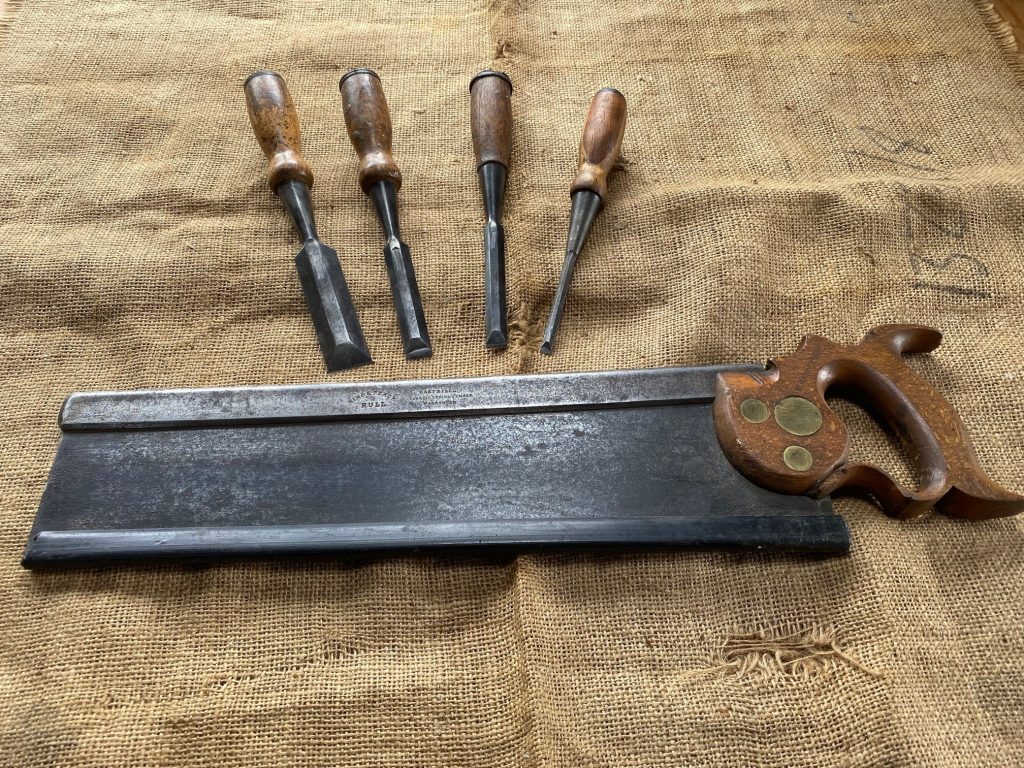
The bar had been dowelled in and glued, but not glued so well as to create damage when removing it. I cleaned up the old putty from the rebate with another Marples chisel from the “to restore” box so the new panel would sit flush. Took my time with the finish because the new glass deserved a tidy home.
And what went in was worth waiting for.
I’ve seen a bit of stained glass over the years. The traditional stuff mostly. Church windows, Victorian door panels, geometric and restrained. The kind of thing you’d expect.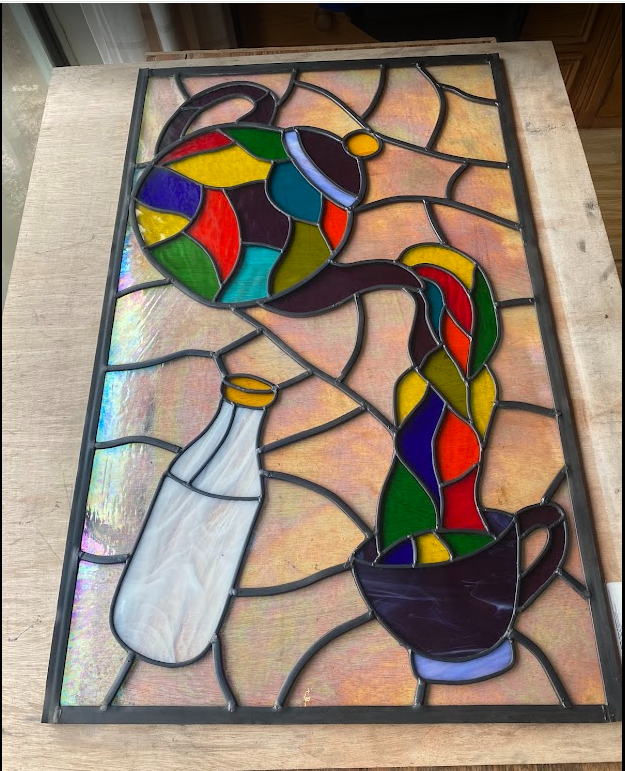
This is not that.
This is a teapot, bold as brass, pouring a stream of tea into a waiting cup. A milk bottle standing to one side. And the colour. I don’t have the words for it, honestly. Let’s just say it will suit its new home perfectly, and when you first clock it through the door, you’ll smile before you’ve registered what you’re looking at.
Her friend, the glassmaker, has real skill. The leading is clean, the composition is confident, and it has a life to it that a lot of stained glass doesn’t.
The kitchen’s going to sing, those two together.
My job was just to make sure it sat safely in the intended spot.
I don’t always write about jobs like this. Most of what I put on here are tools; woodwise, it’s generally picture frames. But every so often, something comes along that’s a reminder of what the tools are actually for.
Not always a grand statement. Sometimes it’s just: take out a bit of wood so your friend’s kitchen door can stop people in their tracks.
Worth doing right, same as owt else.